 |
Karl King's Music
Karl King's best-known composition has to be Barnum and Bailey's
Favorite. This march has the power to conjure up the whole magnificent
scene of the old tent circus -- all the aromas, all the sounds, all the
sights, and, of course, the circus band. King wrote this march for the
thirty-two-piece Barnum
and Bailey Circus Band in 1913 at the request of the director. King
was twenty-two at the time and was preparing to join the band as a euphonium
player. The euphonium can be heard in a rousing countermelody. His use
of the word 'favorite' in the title proved quite appropriate, as a 1980
international music survey ranked this march fourth in the top 140 marches. |
Complete listing of Karl King compositions (listed
by title, showing date and publisher)
A - B
- C - D - E
- F - G - H
- I - J - K
- L - M - N
- O - P - Q - R
- S - T- U
- V - W - X - Y
- Z
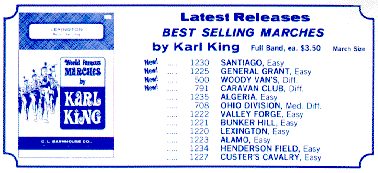
listing of Karl King compositions sold in march
size books
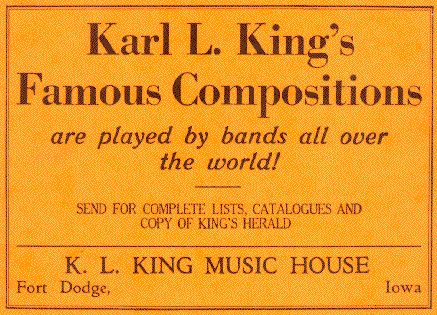
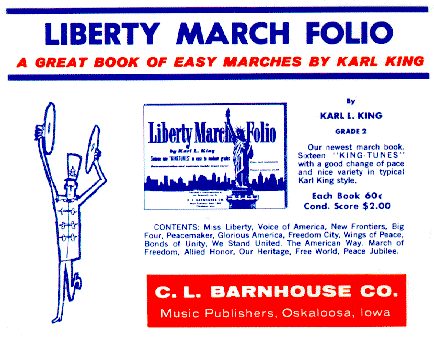
Sales Brochures issued by K. L. King Music
House
Recordings of Karl King's music
The Big Cage
Karl always seemed to enjoy playing his galops, particularly The
Big Cage, which was dedicated to the lion tamer, Clyde Beatty. Mr.
King directed his galops in one beat per measure at about a quarter note=240.
He commented that he wrote his galops as a matter of necessity.
Many times the snare drummer would not play after-beats, but instead
played straight eighth notes throughout. An interesting point about galops:
Mr. King said that in his circus bands he did not use French horns for
galops as they could not speak fast enough. He used E flat alto horns instead.
Even then, it was difficult for them to play the after-beats at such a
rapid tempo. As might be expected, Mr. King demanded strong accents where
written.
The Purple Pageant
This concert march was dedicated by King to Glenn C. Bainum, Director
of Bands at Northwestern University. In his 27 years of service as conductor
of the bands, choirs, and orchestras, Bainum provided the leadership that
was at a level set by William D. Revelli at the University of Michigan
and A. A. Harding at the University of Illinois. He developed many new
and spectacular formations with the electrically illuminated 200-member
marching band. One can assume that the title of the march is a tribute
to the pageantry of the purple uniformed bandsmen presenting one of these
shows.
Mr. King played this march frequently; it is thought to be one of
his truly great marches. Mr. King never played it at a fast tempo, but
generally around half-note=100.
The Trombone King
The Trombone King was published in 1945 and was dedicated
to Charlie Toops, a trombonist and bandmaster in Wilmington, Ohio. As might
be expected, the trombone part rarely calms down during this march -- nor
any King march, for that matter. As a former euphonium player, King made
sure that the low brass players shared the best melodies. The Trombone
King was performed often by the King Band at a tempo of half-note=120
to 128.
Emblem of Freedom
Mr. King has said that he felt that this was perhaps the finest
march he ever wrote. He dedicated it to his friend, Robert D. Hamilton.
The Goldman Band
Mr. King frequently played this march which he had dedicated to
the late Edwin Franko Goldman.
Cyrus the Great
This march was written for Mr. Cy Tremain of Fort Dodge, Iowa.
Mr. Tremain was a very colorful character and was once the bass drummer
and publicity manager of the Fort Dodge Municipal Band. He was a personal
friend of Mr. King. This march was used by the Hagenback-Wallace Circus
for the grand entry. The march is in a minor key and has some interesting
harmonic changes that do not occur in other Karl King marches.
Garland Entree
This is one of Mr. King's earliest marches. It was dedicated to
Mr. W. P. English, who at the time was Bandmaster with the Sells-Floto
Circus. This was the music for the 1912 grand entry in which all participants
wore garlands of flowers. Karl had a keen sense of timing, and he always
set the tempo according to the mood or occasion, varying between quarter-note
= 120 to 132.
Henderson Field
Written in 1943, Henderson Field is named after the
airfield on Guadalcanal (Solomon Islands). In 1942, World War II
was well underway. Allied reconnaissance revealed Japanese constructing
an airfield on the island of Guadalcanal. The location would provide
a strategic location of control for the Japanese. U.S. forces began
planning an invasion of the island known as Operation Watchtower.
The invasion took place August 7, 1942. Within two weeks the Americans
had secured the airfield. It was named Henderson Field after
Major Lofton Henderson, a Marine pilot killed at the battle of Midway in
June 1942.

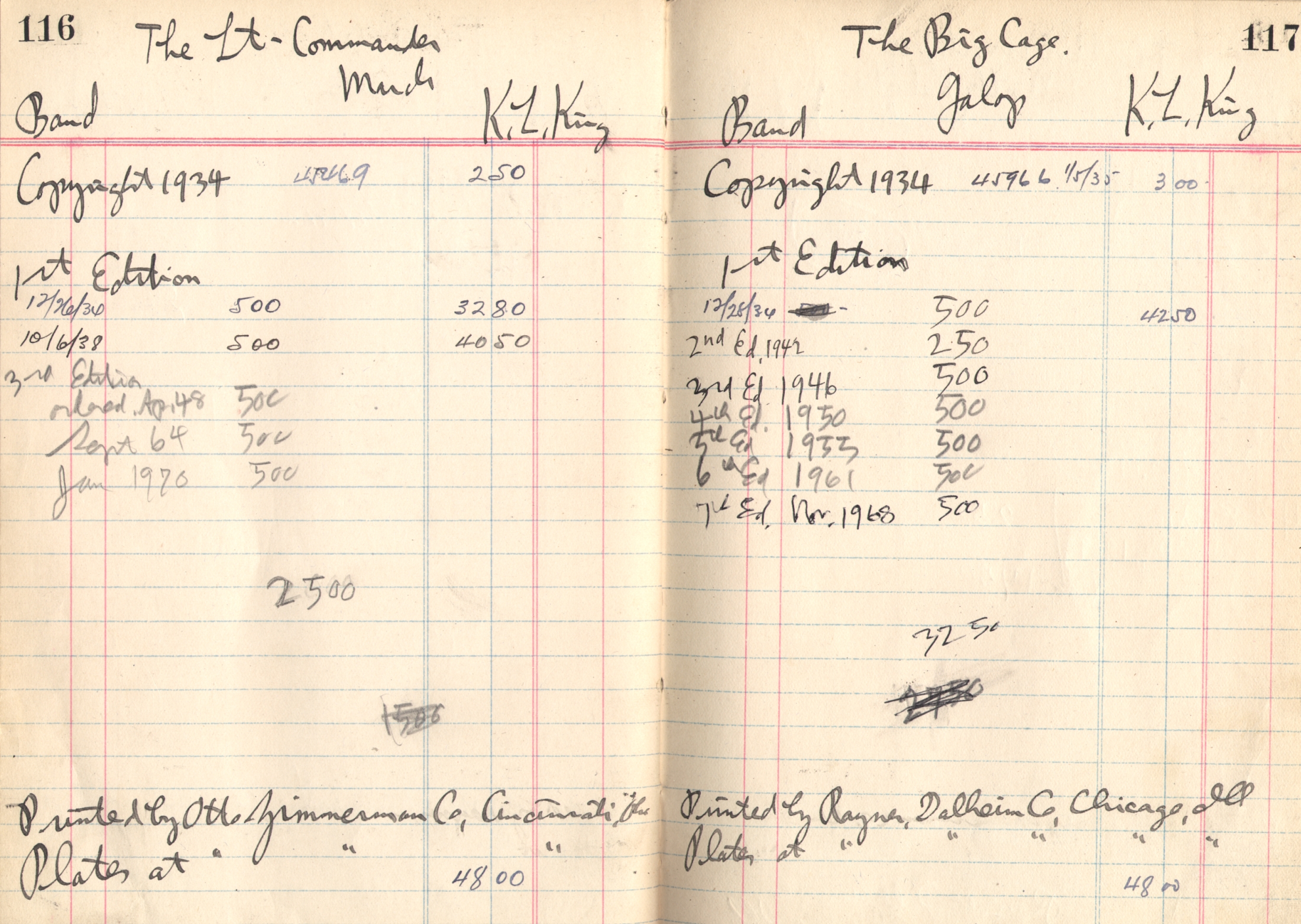
Here is a page in Mr. King's own handwriting from the the K. L. King
Music House ledger showing the printing statistics of two of Karl's
marches. The right hand pane shows the $3.00 January 5, 1935, copyright
fee for The Big Cage Galop. It shows that the original plates
were engraved by the Rayner Dalheim Company of Chicago at a cost of $48.
The plates were also stored there. The ledger shows the first printing
was of 500 copies in 12/28/36 at a cost of $42.50. By the time of
the 7th edition of 500 copies were printed, the total was 3250 copies.
The left pane shows the details for the Lt. Commander March
which was engraved by the Otto Zimmerman Company of Cincinnati,
Ohio.

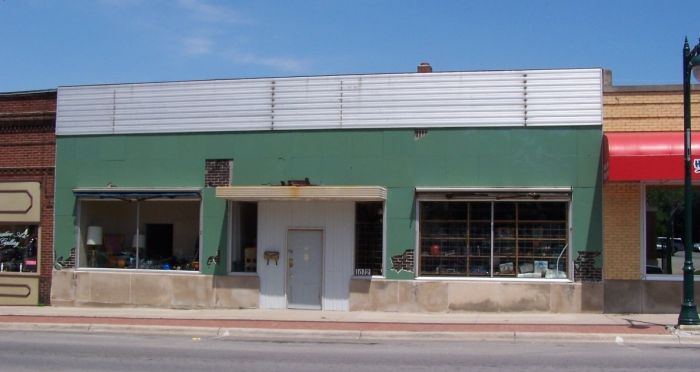
This is the Arcade Building at 1012 Second
Avenue in Fort Dodge. The front door opens to a wide common hallway with
a huge skylight. The east (or right) side of the building was divided
into three rooms; Karl King Music House was in the back while Ruth
used the front two rooms for her Ruth
King Music Shoppe. Instrument displays once filled the front
window. Don Peterson had his photography business in the west half
of the building. Several well known photos of Karl King have the
imprint Don Peterson, Ft. Dodge IA.

Duane Olson reports that while the building has now fallen into disrepair,
that it was a quality building with a handsome brick exterier which has
been covered with a "modern" facade.
Karl King melodies used in songs
arranged by others
Melody a la King
Melody a la King was arranged by Harry L. Alford and published
by C. L. Barnhouse in 1941. It had been commissioned by Barnhouse in 1939
to honor Mr. King who was then president of the American Bandmasters Association.
Mr. Alford used melodies from King's Barnum and Bailey's Favorite,
Princess
of India Overture, the waltz In a Moonlit Garden, the baritone
solo and trio melody from A Night in June, the waltz
Golden Dragon,
Fountain
of Youth, and Prince Charming.
March of Time
March of Time was arranged by J. J. Richards and published
by Barnhouse in 1936 to celebrate the 50th anniversary of the Barnhouse
company (1886-1936). Richards used parts of six famous marches that had
been published by Barnhouse. He used Fred Jewell's Gentry's Triumphal
for the introduction and 1st strain, G. L. Holmes' The Banqueters
for the 2nd strain. For the trio, he used Barnhouse's Messinger,
J. J. Richards' The Waltonian, Karl's Barnum and Bailey's Favorite,
and Russell Alexander's Tropic to Tropic.
Indiana, Our Indiana
Indiana, Our Indiana was written by
Russell P. Harker and Karl King and was published by Indiana Union in 1913.
Harker composed the first part of this march and used the trio of Karl
King's Viking as the melody strain. This piece is used by Indiana
University.
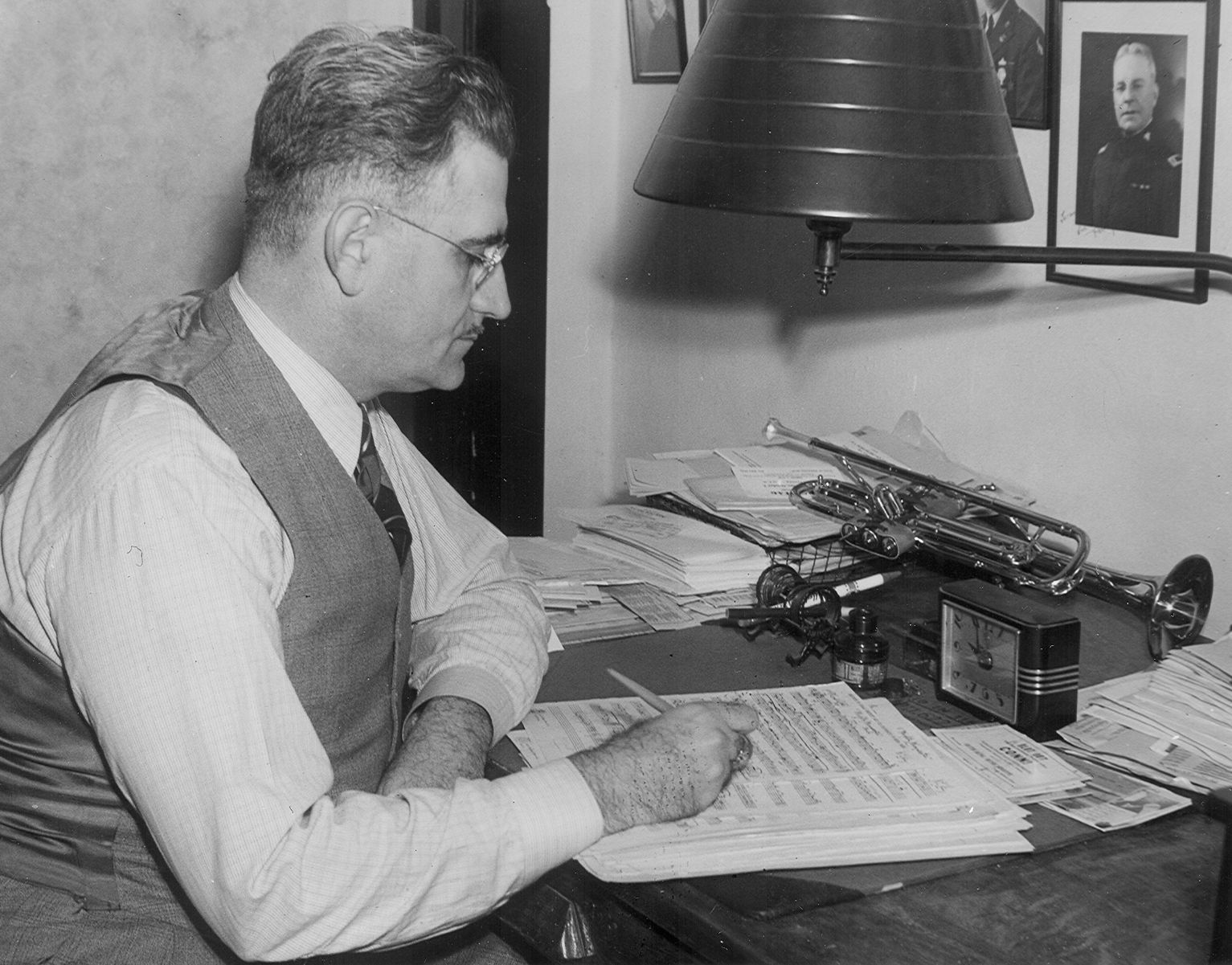
Karl King at his composing desk
See the manuscript pens which
Karl King used when he composed.
View the book which Karl King studied to
learn music theory.
|
Publishing Companies used
by Karl King
|
C. L. Barnhouse Co.
Oskaloosa, Iowa |
|
J. E. Agnew
Des Moines, Iowa
(using pen name Carl Lawrence) |
Fillmore Brothers Inc.
Pittsburgh, Pennsylvania |
|
Karl L. King Music House
Fort Dodge, Iowa |
R. F. Seitz
Glen Rock, Pennsylvania |
|
William E. Strassner
Canton, Ohio |
Volkwein Brothers Inc.
Pittsburgh, Pennsylvania |
|
Rubank Inc.
Chicago, Illinois |
back to the Karl King Page